How to Create a Data-Driven Growth Marketing Strategy (Step-by-Step)
What Is a Data-Driven Growth Marketing Strategy?
A data-driven growth marketing strategy is a systematic approach where every decision — from channel selection to creative messaging — is grounded in measurable evidence rather than gut instinct. Unlike traditional marketing, which often treats data as a post-campaign report card, growth marketing uses data as the steering wheel from day one.
The distinction matters more than it might seem. Traditional marketing campaigns are typically planned in advance, executed, and then assessed. A growth marketing strategy runs on a continuous loop: form a hypothesis, run an experiment, read the data, and adjust. This means campaigns evolve in real time rather than waiting for a quarterly review.
For brand studios and marketing teams, this approach doesn't replace creativity — it focuses it. Data tells you where to be creative and for whom, so your best ideas land with the right audience at the right moment.
Start With the Right Metrics — Define Your North Star
Before collecting a single data point, your team needs to agree on one primary success metric: your North Star Metric. This is the single number that best captures the core value your product or service delivers to customers.
For a SaaS company, that might be weekly active users. For an e-commerce brand, it could be repeat purchase rate. For a content platform, time spent per session. The North Star Metric is not revenue itself — revenue is a consequence. The North Star is the behavior that reliably predicts revenue growth over time.
Why does this matter so much? Because without a shared anchor, different teams optimize for different things. Sales pushes volume. Product pushes engagement. Marketing pushes traffic. The North Star aligns everyone around the same outcome and makes your key performance indicators (KPIs) coherent rather than contradictory.
Once you have your North Star, layer in supporting KPIs for each funnel stage. At acquisition, track customer acquisition cost (CAC). At retention, watch customer lifetime value (CLV). These two metrics together — and specifically their ratio — tell you whether your growth is sustainable or just expensive.
Map Your Marketing Funnel and Identify Data Gaps
Mapping your marketing funnel means tracing every stage a customer moves through, from first awareness to long-term retention, and identifying where your data is solid versus where you're flying blind.
The classic growth framework — Acquisition, Activation, Retention, Referral, Revenue (AARRR) — gives you a practical scaffold. Work through each stage and ask two questions: What behavior signals progress here? And do we have reliable data tracking that behavior?
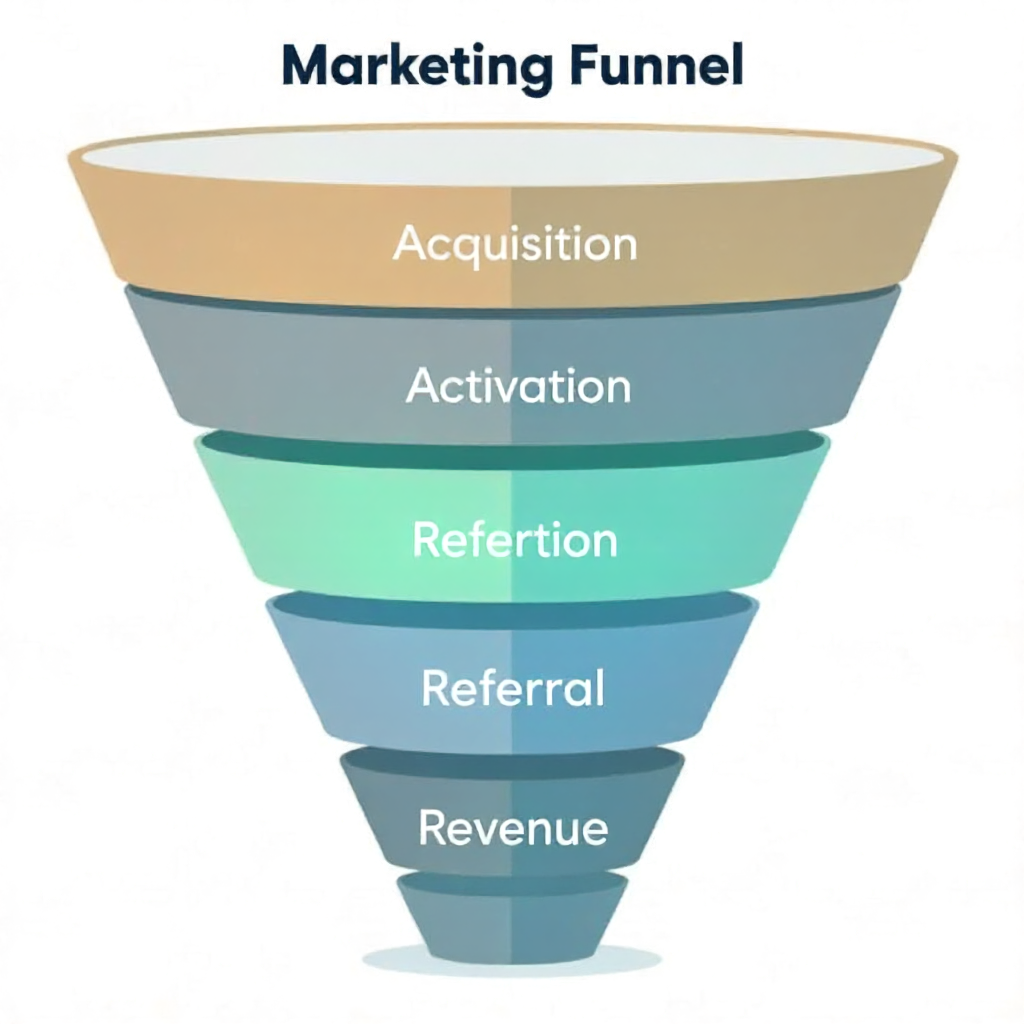
Most teams discover the same pattern: acquisition data is relatively clean (ad platforms track clicks obsessively), but activation and retention data gets murky fast. If you can't tell when a new user first experiences genuine value from your product, you can't optimize for that moment — and that moment is often where growth stalls.
A practical audit looks like this:
- List every touchpoint in the customer journey
- Identify the metric that defines success at each stage
- Check whether that metric is currently being tracked accurately
- Flag stages where data is missing, inconsistent, or siloed across platforms
Fixing data gaps before running campaigns saves enormous time. Optimizing a funnel with broken tracking is like navigating with a map that's missing half the roads.
Segment Your Audience Using Behavioral and Demographic Data
Audience segmentation transforms a broad dataset into actionable targeting — it's the difference between sending one message to everyone and sending the right message to the right person.
Start with demographic data: age, location, job title, company size if you're B2B. This gives you basic clusters. But behavioral data is where segmentation becomes genuinely powerful. Which pages do different users visit? What features do they use first? When do they drop off? Which users convert to paid plans within 14 days versus never?
Combining both data types lets you build segments that reflect real patterns in how people interact with your brand. A 35-year-old founder who visited your pricing page three times in a week is a very different prospect than a 35-year-old founder who read one blog post six months ago — even though they look identical in a demographic report.
Effective segmentation directly shapes channel strategy, messaging tone, and offer structure. High-intent behavioral segments often respond better to direct conversion-focused messaging. Early-awareness segments need education and credibility-building first. Treating them the same wastes both budget and creative energy.
Build an Experimentation Framework (Test, Learn, Scale)
An experimentation framework is a repeatable process for running structured tests — primarily A/B testing — so that growth decisions are validated by evidence, not advocacy.
The core loop is simple: form a hypothesis, define success criteria before you start, run the test with a statistically meaningful sample, read the results honestly, and decide whether to scale, iterate, or discard. The discipline is in the details, particularly in defining success criteria upfront. Teams that set their targets after seeing results are unconsciously cherry-picking wins.
A lightweight experimentation framework for smaller teams might look like this:
- Hypothesis log: A shared document where anyone can submit a testable idea with a predicted outcome
- Prioritization score: Rate each idea by potential impact, confidence level, and ease of implementation
- Test calendar: Run one to three experiments per week, depending on traffic volume
- Results archive: Document every outcome, including failures — failed tests teach as much as wins
One honest limitation: A/B testing requires sufficient traffic to reach statistical significance. Early-stage brands with low monthly visitors may need to run tests longer or focus on qualitative methods — user interviews, session recordings — to gather directional evidence before scaling experiments.
Turn Insights Into Creative and Campaign Decisions
Data insights should directly shape creative output — the headlines you write, the offers you build, the channels you prioritize. This is where growth marketing and brand strategy converge.
If your conversion rate optimization (CRO) data shows that users who read a specific blog post convert at 3x the average rate, that's a creative brief. Write more content on that topic. Build a landing page that mirrors its framing. Use its headline structure as a template for ad copy.
Similarly, if your segmentation data shows that a particular audience cohort responds to social proof while another responds to technical specifications, those are two different creative directions — not one compromise message that serves neither well.
The mindset shift here is treating data as creative input, not just performance output. Analytics teams and creative teams need to work from the same evidence base. When a campaign underperforms, the question isn't "was the creative bad?" — it's "what did the data predict, what happened, and what does that tell us?"
Measure, Iterate, and Scale What Works
A growth marketing strategy is never finished — it's a system that gets sharper over time through consistent measurement and honest iteration.
Set a review cadence that matches your business velocity. Early-stage startups often benefit from weekly KPI check-ins and monthly strategy reviews. More established brands might run bi-weekly reviews with a quarterly deep-dive. The frequency matters less than the consistency: growth compounds when teams review the same metrics in the same format over time, because patterns only become visible across multiple data points.
Build a KPI dashboard that shows your North Star Metric at the top, followed by the supporting metrics for each funnel stage. Keep it focused — dashboards with 40 metrics tell you nothing. Dashboards with 8 well-chosen metrics tell you almost everything you need to act.
When something works, scale it deliberately. Doubling a budget on a winning channel doesn't always double results — diminishing returns are real, and audience saturation happens faster than most teams expect. Scale in increments, monitor CAC and CLV closely as you grow, and resist the temptation to abandon experimentation once you find a channel that works. Markets shift, audiences evolve, and last year's winning playbook becomes this year's plateau.
Frequently Asked Questions
What is the difference between growth marketing and traditional marketing?
Traditional marketing typically focuses on awareness and brand-building through planned campaigns. Growth marketing operates across the full customer lifecycle — acquisition through retention — using continuous experimentation and data analysis to optimize at every stage. The core difference is the feedback loop: growth marketing adapts in real time rather than waiting for campaign post-mortems.
How much data do you need before starting a growth marketing strategy?
You need enough data to make directional decisions, not statistically perfect ones. For most early-stage brands, 4-8 weeks of baseline tracking across your key funnel stages is enough to start forming hypotheses and running experiments. Waiting for a "complete" dataset is one of the most common reasons growth stalls before it begins.
Which metrics matter most for early-stage brands?
At the early stage, focus on CAC, activation rate (the percentage of new users who complete a key action), and retention over 30 and 90 days. These three metrics reveal whether you can acquire customers efficiently, whether they find value quickly, and whether they stay. CLV becomes more meaningful once you have enough retention data to project it reliably.
How often should a growth marketing strategy be reviewed or updated?
Tactical elements — channel performance, campaign results, A/B test outcomes — should be reviewed weekly or bi-weekly. The broader strategy, including your North Star Metric, audience segmentation approach, and funnel priorities, should be revisited quarterly or whenever there's a significant shift in market conditions, product offering, or business model.
Can small teams implement a data-driven growth strategy without expensive tools?
Yes. A spreadsheet-based hypothesis log, free-tier analytics, and a basic email platform are enough to run a structured growth process. The methodology matters far more than the toolstack. Many high-performing growth teams at early-stage companies run lean on tools and heavy on discipline — consistent tracking, honest review, and a genuine willingness to act on what the data shows.