The Role of Brand Storytelling in Modern Marketing: Strategy, Impact, and Execution
Most brands have a product. Fewer have a story. And the gap between those two things is where loyalty, conversion, and long-term growth actually live. Brand storytelling has become one of the most discussed concepts in marketing — but also one of the most misapplied. This guide cuts through the noise to show what it really means, why it works, and how to build it into your brand strategy from the ground up.
What Brand Storytelling Actually Means Today
Brand storytelling is the practice of using narrative structure — not just messaging — to communicate who a brand is, what it stands for, and why that matters to the people it serves. It goes beyond a catchy tagline or a polished origin story on your About page.
In a crowded marketing landscape where audiences are exposed to thousands of brand messages daily, product features and price comparisons are nearly impossible to sustain as differentiators. A brand narrative creates a frame through which every piece of content, every campaign, and every customer interaction becomes part of something larger and more meaningful.
Think of it this way: Apple doesn't sell computers. It sells the belief that individuals can challenge the status quo. Patagonia doesn't sell jackets. It sells a commitment to protecting the planet. The product is the vehicle. The story is the destination.
Modern brand storytelling operates across the entire customer journey — from the first touchpoint that sparks awareness to the post-purchase experience that turns a buyer into an advocate. It's a strategic layer, not a creative add-on.
Why Storytelling Outperforms Feature-Led Marketing
Narrative-driven marketing consistently outperforms feature-led messaging because the human brain is wired to process stories differently than data. When people encounter a list of product specifications, the analytical regions of the brain activate. When they encounter a story, multiple areas light up — including those associated with emotion, sensory experience, and memory.
This has direct implications for audience trust and purchase behavior. Research in cognitive science consistently shows that emotionally resonant content is retained far longer and recalled more vividly than factual content alone. A brand that makes someone feel something creates a neurological shortcut to preference.
Feature-led marketing also creates a fragile competitive position. If your differentiator is a faster load time or a lower price, you're one product update away from irrelevance. An emotional connection built through story is much harder for competitors to replicate — because it's rooted in values, voice, and relationship, not specs.
There's also a trust dimension. Audiences have grown deeply skeptical of promotional messaging. Authentic storytelling — particularly when it acknowledges struggle, imperfection, or genuine purpose — bypasses that skepticism in ways that polished ad copy simply cannot.
The Core Elements of an Effective Brand Story
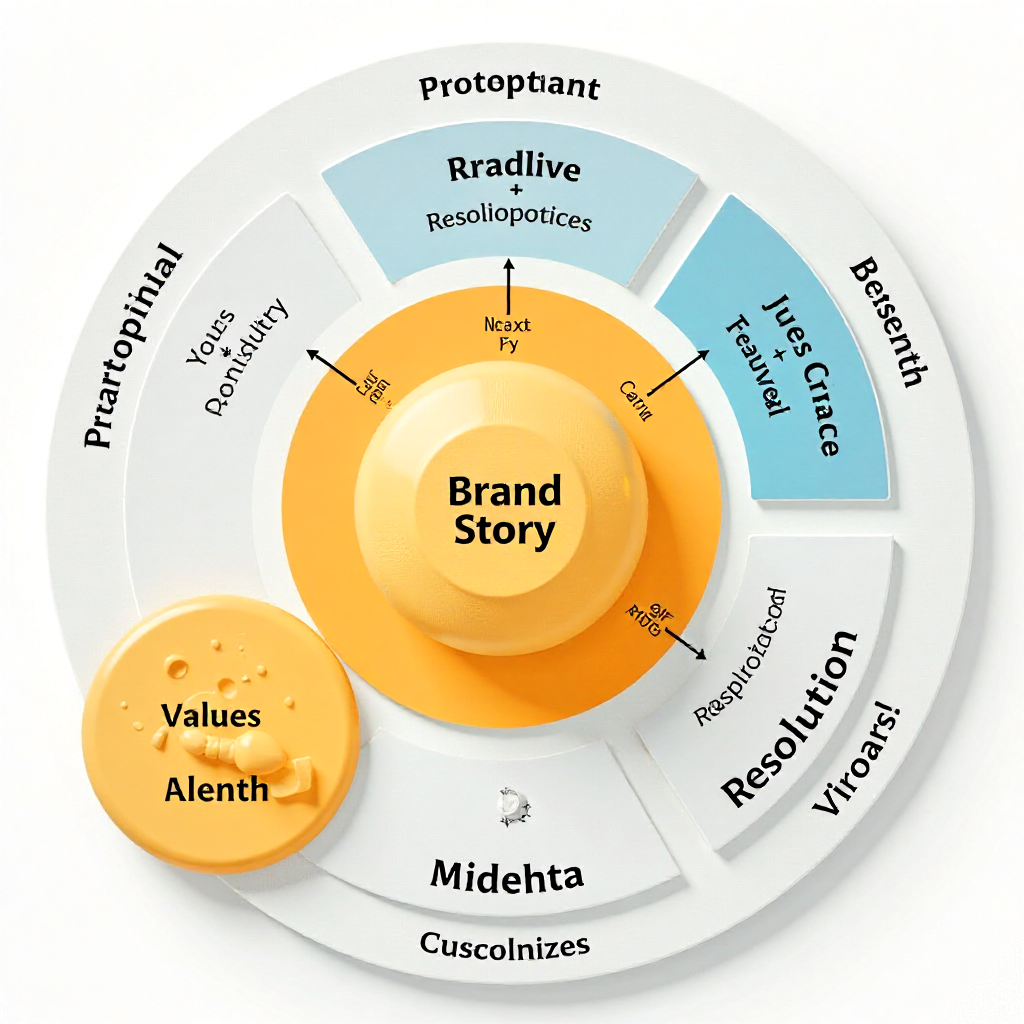
A compelling brand story shares the same structural DNA as any good narrative: a protagonist, a conflict, and a resolution — anchored in clear values. Strip away any one of these and the story loses its grip.
Here's how each element maps to brand strategy:
- Protagonist: In most effective brand stories, the customer — not the brand — is the hero. The brand plays the role of guide or enabler. This reframing shifts the narrative from self-promotion to genuine service.
- Conflict: What problem, frustration, or aspiration is your customer navigating? The conflict is the emotional engine of the story. Without it, there's no tension, no stakes, and no reason to keep reading.
- Resolution: How does the brand help the protagonist reach a better state? This is where your product or service earns its place in the narrative — not as the point, but as the solution.
- Values: The underlying beliefs that make your brand's version of this story uniquely yours. Values give the narrative consistency and make authentic messaging possible across every channel and format.
A brand that can articulate all four of these elements clearly has the foundation for a brand identity that scales — from a 15-second social ad to a 2,000-word long-form piece.
How Growth Marketing and Storytelling Work Together
Growth marketing and brand storytelling are not competing priorities — they're most effective when they reinforce each other. Storytelling provides the emotional architecture that makes growth tactics actually convert.
Consider the acquisition stage. A paid ad built around a compelling narrative — a real customer's before-and-after, a brand's founding moment, a challenge the audience recognizes — will consistently outperform a generic feature-benefit ad in click-through and conversion rates. The story creates context that makes the offer feel relevant rather than intrusive.
At the retention stage, conversion storytelling becomes even more critical. Brands that communicate ongoing narrative — through email sequences, community content, or product updates framed as chapters in a larger journey — see meaningfully higher lifetime value. Customers aren't just buying again; they're staying part of something.
The link to content marketing is equally direct. Narrative-driven content earns organic traffic, backlinks, and social sharing at higher rates than purely informational content because it gives audiences something to connect with and pass on. Growth marketers who treat storytelling as a soft, brand-awareness-only tool are leaving measurable acquisition and retention value on the table.
Building a Consistent Brand Voice Across Channels
A brand voice is the consistent personality and tone that carries your story across every format and platform. Without it, even a strong brand narrative fragments into disconnected content that audiences can't recognize or trust.
Consistency doesn't mean uniformity. A brand's voice on LinkedIn will naturally differ in register from its voice in an Instagram Story — but the underlying personality, values, and perspective should be unmistakably the same. Think of it like a person who speaks differently at a conference than at a dinner party, but is still recognizably themselves.
Practically, maintaining story coherence across channels requires a few foundational decisions:
- A documented voice and tone guide that goes beyond adjectives — it should include examples of what the brand would and wouldn't say
- A clear articulation of the brand's core narrative that any team member or agency partner can reference
- A content review process that checks not just accuracy but tonal alignment
Brands that invest in voice consistency build audience trust faster because every interaction reinforces the same impression. Those that don't often find that their storytelling efforts feel scattered — and scattered stories don't build loyalty.
Common Brand Storytelling Mistakes to Avoid
Most brand storytelling failures come down to a handful of recurring patterns. Recognizing them early saves significant time, budget, and credibility.
Telling the Brand's Story Instead of the Customer's
This is the most common mistake. Brands spend enormous effort crafting founder narratives, mission statements, and company timelines — content that is primarily interesting to the brand itself. Audiences don't engage with stories they can't see themselves in. The fix: reframe every piece of narrative content around the customer's experience, aspiration, or problem.
Confusing Authenticity with Vulnerability Theater
Authentic messaging does not mean oversharing or performing struggle for engagement. Audiences are perceptive — they can tell the difference between a brand that genuinely stands for something and one that has adopted a tone of authenticity as a tactic. The consequence of the latter is a trust collapse that's difficult to recover from. Authenticity comes from consistent behavior over time, not from a single candid post.
Inconsistency Across Touchpoints
A brand that tells one story on its website and a different story in its email campaigns creates cognitive dissonance. Audiences notice misalignment even when they can't articulate it — it registers as a vague sense that the brand isn't quite trustworthy. Maintaining a consistent brand identity across every channel is not a design problem; it's a strategy problem.
Treating Storytelling as Top-of-Funnel Only
Many marketing teams deploy narrative for awareness campaigns and then switch to transactional messaging the moment a prospect moves down the funnel. This breaks the story at exactly the moment it could be most persuasive. The most effective brands carry narrative logic through to conversion and retention, making every stage of the customer journey feel like part of a coherent experience.
How to Start Crafting Your Brand Story Today
The best starting point is a simple audit of what your brand currently communicates versus what it actually believes. Most brands discover a gap — and that gap is where the real storytelling work begins.
A practical framework for getting started:
- Define your protagonist: Who is your customer, and what are they trying to achieve or overcome? Be specific — a vague audience produces a vague story.
- Name the conflict: What stands between your customer and what they want? This should be something your brand genuinely understands and has a perspective on.
- Articulate your role: How does your brand help — and why are you uniquely positioned to do so? Ground this in real capability, not aspiration.
- Identify your values: What does your brand believe that shapes how it operates? Values only count if they influence actual decisions.
- Test for consistency: Run your last five pieces of content through this framework. Do they all tell the same story? If not, you've found your first priority.
This isn't a one-time exercise. Brand narratives evolve as markets shift, audiences change, and brands grow. The goal isn't a perfect story told once — it's a living narrative that gets refined through ongoing attention and honest feedback.
Frequently Asked Questions
What is the difference between brand storytelling and content marketing?
Content marketing is a distribution strategy — it describes the practice of creating and publishing valuable content to attract and retain an audience. Brand storytelling is the narrative layer that gives that content coherence and emotional resonance. You can do content marketing without storytelling (most brands do), but content built on a strong brand narrative consistently performs better across every metric that matters.
How do small brands compete through storytelling without large budgets?
Small brands often have a genuine advantage here. Authenticity and specificity — the two things that make stories work — are easier to achieve at a smaller scale. A founder's direct voice, a tight community, a genuinely distinctive point of view: these are harder for large brands to manufacture. Budget matters far less than clarity of narrative and consistency of execution.
How does brand storytelling affect SEO and organic growth?
Narrative-driven content tends to earn longer dwell times, more social shares, and stronger backlink profiles than purely informational content — all of which are meaningful signals for organic search performance. A compelling brand story also creates content that people actively seek out and return to, which compounds over time into measurable organic growth.
How often should a brand refresh or evolve its narrative?
There's no fixed schedule. A brand should revisit its narrative when its audience shifts significantly, when the competitive landscape changes, or when internal values and direction evolve. The core story — rooted in genuine values and customer truth — should be durable. The expression of that story can and should evolve regularly to stay relevant.
Can storytelling work for B2B brands, not just consumer brands?
B2B buyers are still human beings making decisions that carry professional and personal stakes. Emotional connection, trust, and narrative resonance matter just as much in B2B contexts — sometimes more, given the complexity and risk involved in enterprise decisions. The most effective B2B brands have understood this for years. The story simply needs to speak to the specific pressures, aspirations, and conflicts that professional buyers navigate.